Airports separate public, sterile, and restricted zones. Full-height turnstiles and speed gates with biometric verification enforce zone boundaries.
Accessible routes through the same perimeter need a dedicated lane rather than a widened turnstile, and the sizing rules are set out in our guide to disabled access gates.
Speed gates (also written as speedgates) control flow at the point where a wide concourse has to be narrowed into a single stream of people, and the speed gate families that SUNFRE builds for that position are specified together with the hall they will stand in. Opening time, cabinet footprint, power distribution and the way a unit is anchored have to match the architecture, which is why the turnstile access control guide treats mechanical arrangement and access control as one decision rather than two.
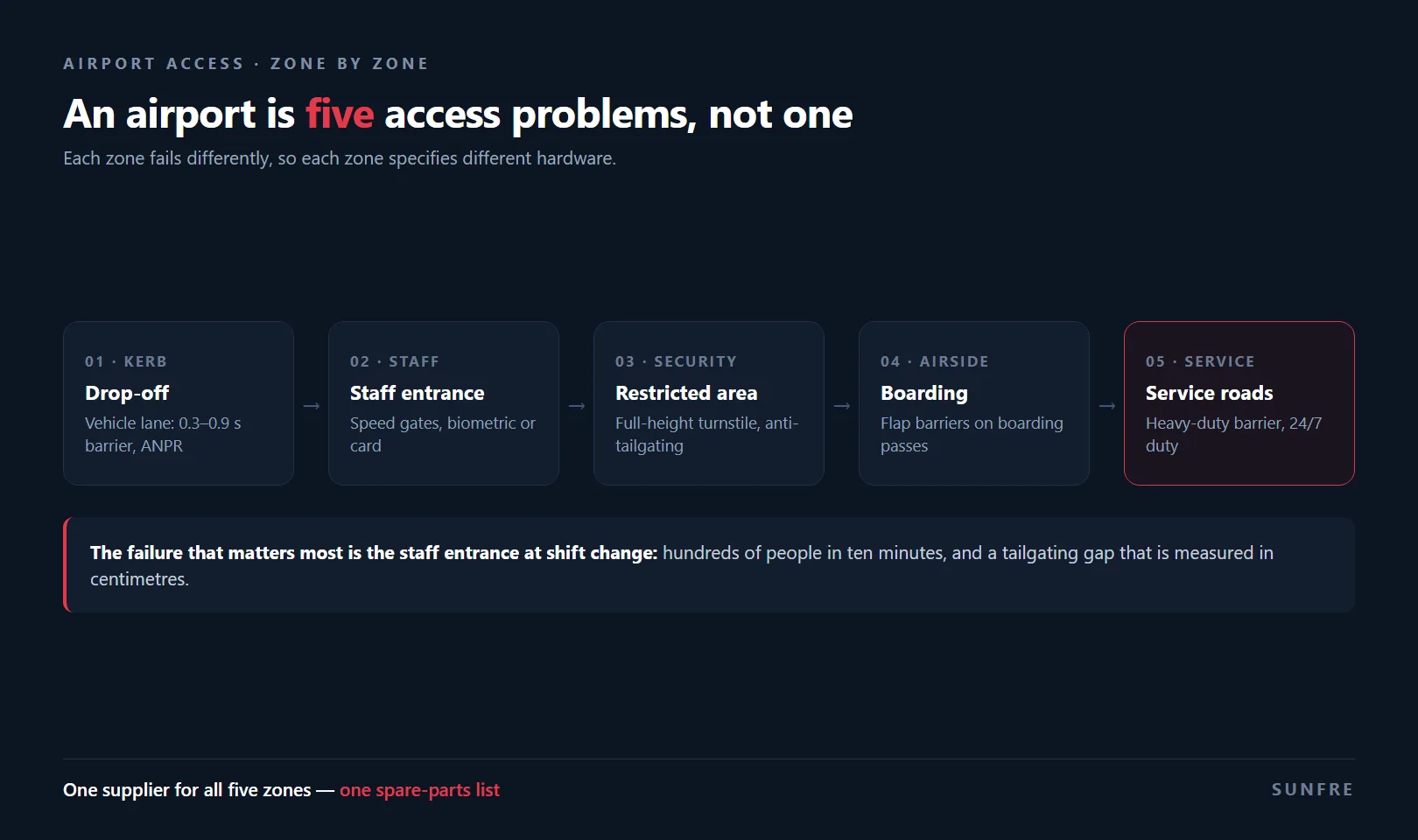
The airside of a terminal is not one access problem but several, because landside arrivals, sterile departures and service traffic pass through the same envelope while following different rules about who may proceed. Full-height turnstiles are used where a zone boundary has to hold a queue physically, speed gates are used where a line has to move quickly and be counted, and vehicle control on service roads and staff car parks is handled separately by barrier gate equipment, as the barrier gates guide describes.
Staff and crew circulate on a schedule that has little to do with the passenger peaks, and the lanes they use are sized for a shift change rather than for a departure bank. A biometric terminal at the entrance to a restricted area verifies identity against a stored record without an operator reading every credential, while the gate itself is chosen for the moment when several hundred people present their cards at once rather than for the way it looks in an open concourse.
Immigration counters and secondary screening rooms are built around a sequence in which the traveller is identified once and then moved through a space where a decision has already been taken. That sequence depends on the verification terminal clearing a record quickly, and on the lane furniture being arranged so that a traveller held for a check does not stop the flow behind them, which is a layout question as much as an equipment question and is worth settling before the hardware is ordered.
See access control applications and biometric & RFID integration.
