

Description
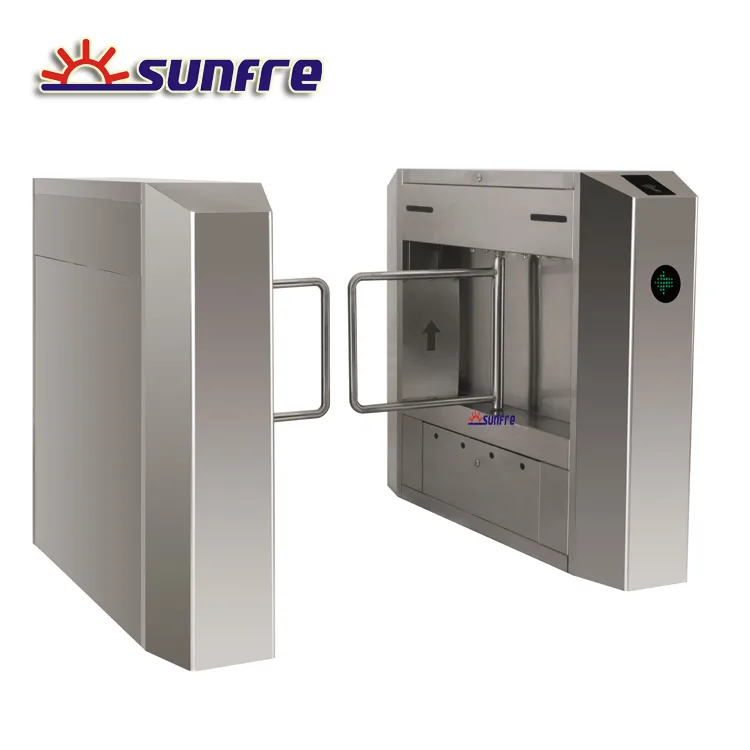
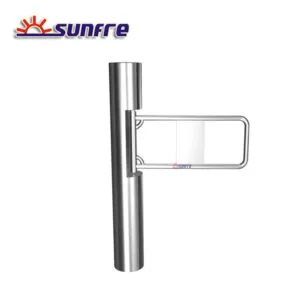
SFSB-A1011 is a swing barrier (speedstile) for indoor lanes that need a faster, wider passage than a tripod turnstile. The gate opens and closes in 0.4 s, passes 50 people per minute, and uses 9 to 10 pairs of infrared sensors to detect tailgating across the full passage.
What the SFSB-A1011 is
A swing barrier is two glass or stainless wings that retract into the cabinet. Where a tripod gives you a rotating arm and a narrow lane, a swing barrier gives you a clear opening that a wheelchair, a trolley or a person with luggage can pass without turning sideways.
The A1011 is built for high-rise lobbies, office receptions, gyms and transit interchanges: places that want a controlled lane that does not look like a security checkpoint. The cabinet is SS304 stainless, 1.5 mm sheet, cut on a CNC laser, with acrylic or stainless wings.
Key features
- 0.4 s gate action. Fast enough that a card read, not the gate, sets the throughput ceiling.
- 9–10 pairs of infrared sensors. Detection spans the passage, not just the centre line, which is what stops one authorised person from admitting two.
- Tailgating and reverse-intrusion alarms. Light and sound indication when someone follows through or enters against the permitted direction.
- Direction indication. Green and red guidance on the cabinet so users do not need a sign.
- Automatic reset. If the authorised person does not pass within the set window, permission expires and the wings close without an operator.
- Fail-safe on power loss. Wings release so the lane clears for evacuation, and the fire-control interface can trigger the same release.
- SS304, 1.5 mm, CNC cut. Brushed stainless (SSB / US32D) as standard, powder coating optional.
- RS485, up to 1,200 m. Lane grouping and remote management from a host system, with online or offline operation.
Specifications
| Model | SFSB-A1011 |
|---|---|
| Type | Swing barrier / speedstile, bi-directional |
| Housing material | SS304 stainless steel, 1.5 mm, CNC laser cut |
| Wing material | Acrylic glass or SS304 |
| Opening / closing time | ≤ 0.4 s |
| Passing speed | 50 persons per minute (normally open or normally closed) |
| Motor | DC brushless, 140 W / 24 V |
| Power supply | AC 220 V ±10 V, 50 Hz |
| Infrared sensors | 9 or 10 pairs |
| Communication | RS485, up to 1,200 m |
| Input signal | +12 V level signal, or pulse wider than 100 ms at DC 12 V, current > 10 mA |
| Operating temperature | −20 °C to +70 °C |
| Relative humidity | < 95%, non-condensing |
| Protection grade | IP54 |
| Finish | SSB (US32D) brushed stainless; powder coating optional |
How the sensing works
The infrared array is not a safety extra; it is what makes the lane a controlled passage rather than a door that opens on a card. Sensors sit across the full width of the opening, at several heights, so the controller knows whether one person or two are inside the passage.
That distinction matters commercially. A lane that counts cards but not people leaks revenue quietly, every day, and nobody notices until the reconciliation does not match. Nine or ten pairs is enough to detect a second body following closely behind the first, and to hold the wings closed while the passage is occupied.
Integration and options
The controller takes a dry-contact release from any reader and closes the lane after a configurable delay. Online mode adds lane grouping, remote mode changes and passage logs over RS485; offline mode keeps the lane working on its local list and reconciles when the link returns.
Finishes are brushed stainless as standard, with powder coating available when the lane has to match a lobby palette. Wings can be acrylic for visibility or stainless where the site expects impact.
Where it fits
- Office and hotel lobbies where a tripod would look out of place.
- Gyms and leisure centres with members carrying bags.
- Transit interchanges and station concourses with high pedestrian flow.
- Accessible lanes: the clear opening passes a wheelchair without the manoeuvring a tripod demands.
The A1011 is an indoor lane with a rainshed option for covered outdoor positions. For a fully exposed site, specify a model rated for it rather than relying on IP54 alone.
FAQ
How wide is the passage?
It depends on the wing length you specify for the opening. Send the clear width you need and the lane will be configured to it; do not assume a single standard width.
Can two people get through on one card?
That is what the infrared array is for. The controller holds the wings while the passage is occupied and raises an alarm if a second person follows.
What happens if the power fails?
The wings release so the lane becomes a free exit, and the fire interface can force the same state. Operation resumes automatically when power returns.
Is it suitable for wheelchair users?
The clear opening and the absence of a rotating arm make it far easier than a tripod. Confirm the wing length and the sensor coverage against your local accessibility requirement before ordering.
Related reading
- Turnstile types compared: tripod, flap, swing and full height
- Accessible lane design: width, force and detection
- Matching access control hardware to site type
Tell us the opening width, throughput and reader type through the quote request form and the lane will be configured to the site rather than to a catalogue page.
Reviews
There are no reviews yet.